A banner showing a stick-figure head with long hair, and five thought bubbles spreading out from it. Each thought bubble has minimalistc icons in it, depicting things like swords, treasure chests, health packs with parachutes, ghosts, and more.

A Game Designer’s Aesthetic

In the first article, I discussed game design patterns, and called them the brushstrokes of game design. In the second article I discussed game genres, and described how they were organic groupings of design patterns that had, over time, been given names. In the third article I discussed game design choices, and how we make them.

It’s time to finally talk about what a personal game design aesthetic is!

A diagram showing an abstract stick figure face with long hair. It has two arrows, one pointing left and one right. In either direction is a circle with a set of different icons in it. The icons are simple and show things like a sword, a stick figure swimming, a tower, and more.

A Game Designer’s Choices

Let’s talk about making choices. Full-time game designers typically make hundreds of choices every day. Most are tiny, some are more substantial. Most are made unconsciously or with only a second of thought, and most of the rest are decided quickly. These quick daily decisions are the engine of our game design aesthetic: they showcase it and refine it.

An image of a venn diagram. Two large circles that overlap in the center. A number of colorful icons with symbol black symbols on them are scattered around the image, some in the overlap, some int he individual circles, and some outside the circles.

 A Game Designer’s Genres

We can all list genres of games: FPS, action-adventure, roguelike, otome, hidden object, and so on. When someone uses these terms we (mostly) know what they mean, and they help to quickly summarize a lot of information. Developers use them as shortcuts to answer a lot of design questions, retailers and award shows use them to categorize, gamers use them to describe games to their friends, marketing uses them to set expectations. Everyone loves to argue about where exactly to draw the lines between them.

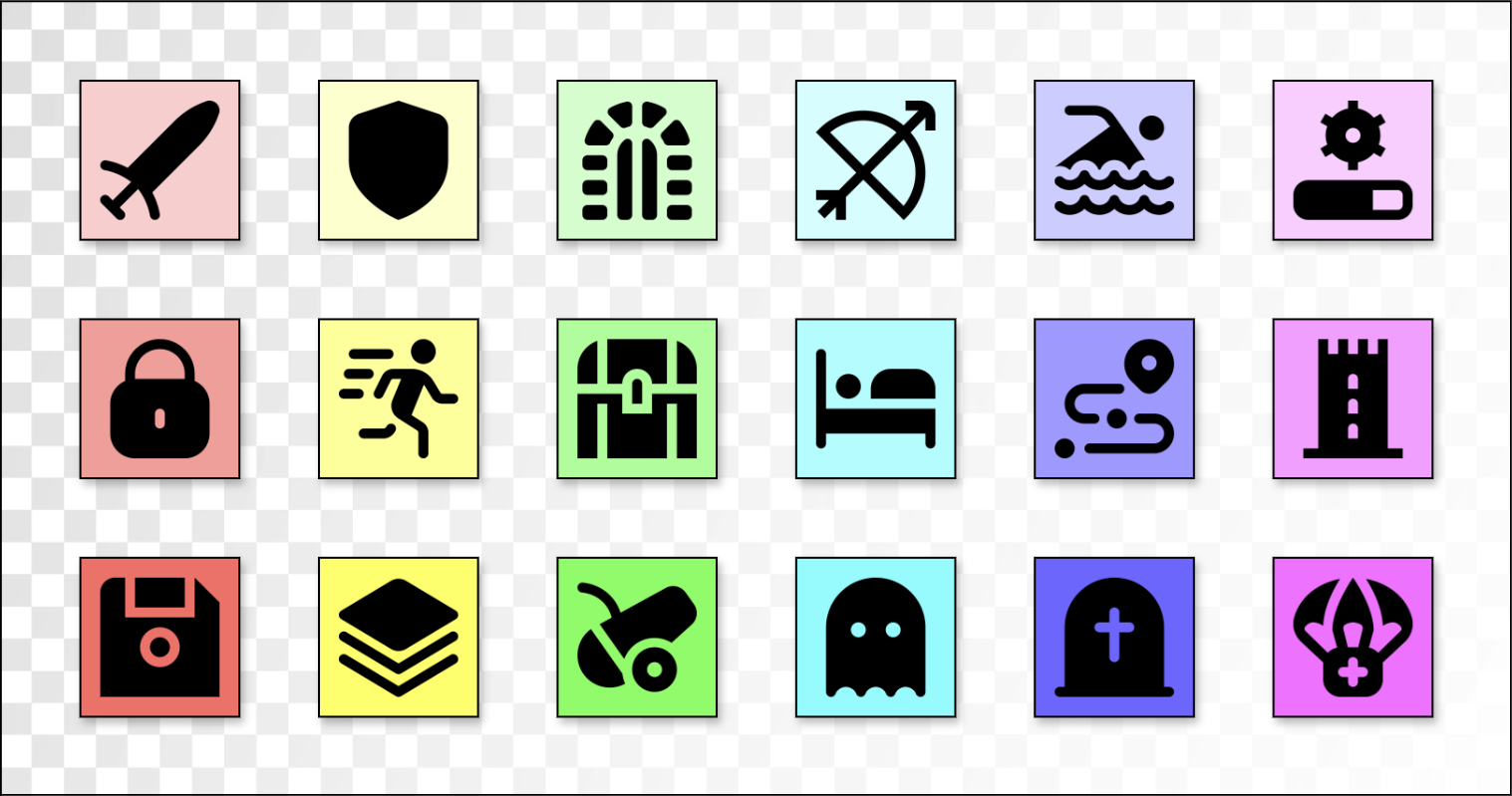
A set of 18 simple icons set atop a checkerboard grid. The icons are various colors, arrayed like a rainbow, and each icon has a solid black symbol: a sword, a shield, a person swimming, a tower, a ghost, a grave, and more.

 A Game Designer’s Brushstrokes

Let’s begin with a basic building block, one of our simplest functional units of game design: design patterns. This concept is borrowed from architecture, coined by architect Christopher Alexander and popularized in his landmark 1977 book, A Pattern Language. Alexander wanted to articulate, describe, and harness the dynamics that allowed architectural styles and forms to naturally evolve and respond to the life of their inhabitants and builders.

In the process he found a general-purpose way to describe a given art or design style from any context, not just architecture.

The store splash screen for Lethal Company

The Appeal of Jank

I am intrigued by the way that younger players from outside the core “AAA” gaming bubble seem to respond super well to games that are… social, lofi, watchable, and “janky”.

Lethal Company, Palworld, everything in Roblox, Five Nights at Freddy’s, even Minecraft.

The “janky” part is the most interesting bit to me. Why is this appealing, why does it work well for this audience in particular?

A background image used throughout the blog website. It is a map. It shows a castle on a bluff above a lake, with a small walled town around it. The lake has rivers flowing out on either side, and is surrounded by forests. The castle is rendered in high detrail and as you go to the edges of the image the map gets sketchier and sketchier

What is “World Design”?

The theme of this class is “World Design”, a subset of Game Design. The goal of this document is to explain what that means!

“World Design” is nebulously defined. Some companies have “World Designer” as a job title, but they don’t necessarily describe the same job. I’ve seen it used to describe traditional mission or level design work, designing vast non-linear spaces in open world games, and even the design of systems or UI related to the game world. So we will use a very broad definition in this class.

If Game Design is…

A background image used throughout the blog website. It is a map. It shows a castle on a bluff above a lake, with a small walled town around it. The lake has rivers flowing out on either side, and is surrounded by forests. The castle is rendered in high detrail and as you go to the edges of the image the map gets sketchier and sketchier

Class Prompt: The Art of Closing

With the end of our semester fast approaching, let’s talk
about “closing” this week!

I use the term “closing” for a set of related things:

The final stage of a project or milestone, where you’re trying to take it over the finish line.

The skills that one uses during that final stage.

The mindset of wanting to close: not leaving loose ends, wrapping up work in a finished state and moving on.