A banner showing a stick-figure head with long hair, and five thought bubbles spreading out from it. Each thought bubble has minimalistc icons in it, depicting things like swords, treasure chests, health packs with parachutes, ghosts, and more.

A Game Designer’s Aesthetic

In the first article, I discussed game design patterns, and called them the brushstrokes of game design. In the second article I discussed game genres, and described how they were organic groupings of design patterns that had, over time, been given names. In the third article I discussed game design choices, and how we make them.

It’s time to finally talk about what a personal game design aesthetic is!

An image of a venn diagram. Two large circles that overlap in the center. A number of colorful icons with symbol black symbols on them are scattered around the image, some in the overlap, some int he individual circles, and some outside the circles.

 A Game Designer’s Genres

We can all list genres of games: FPS, action-adventure, roguelike, otome, hidden object, and so on. When someone uses these terms we (mostly) know what they mean, and they help to quickly summarize a lot of information. Developers use them as shortcuts to answer a lot of design questions, retailers and award shows use them to categorize, gamers use them to describe games to their friends, marketing uses them to set expectations. Everyone loves to argue about where exactly to draw the lines between them.

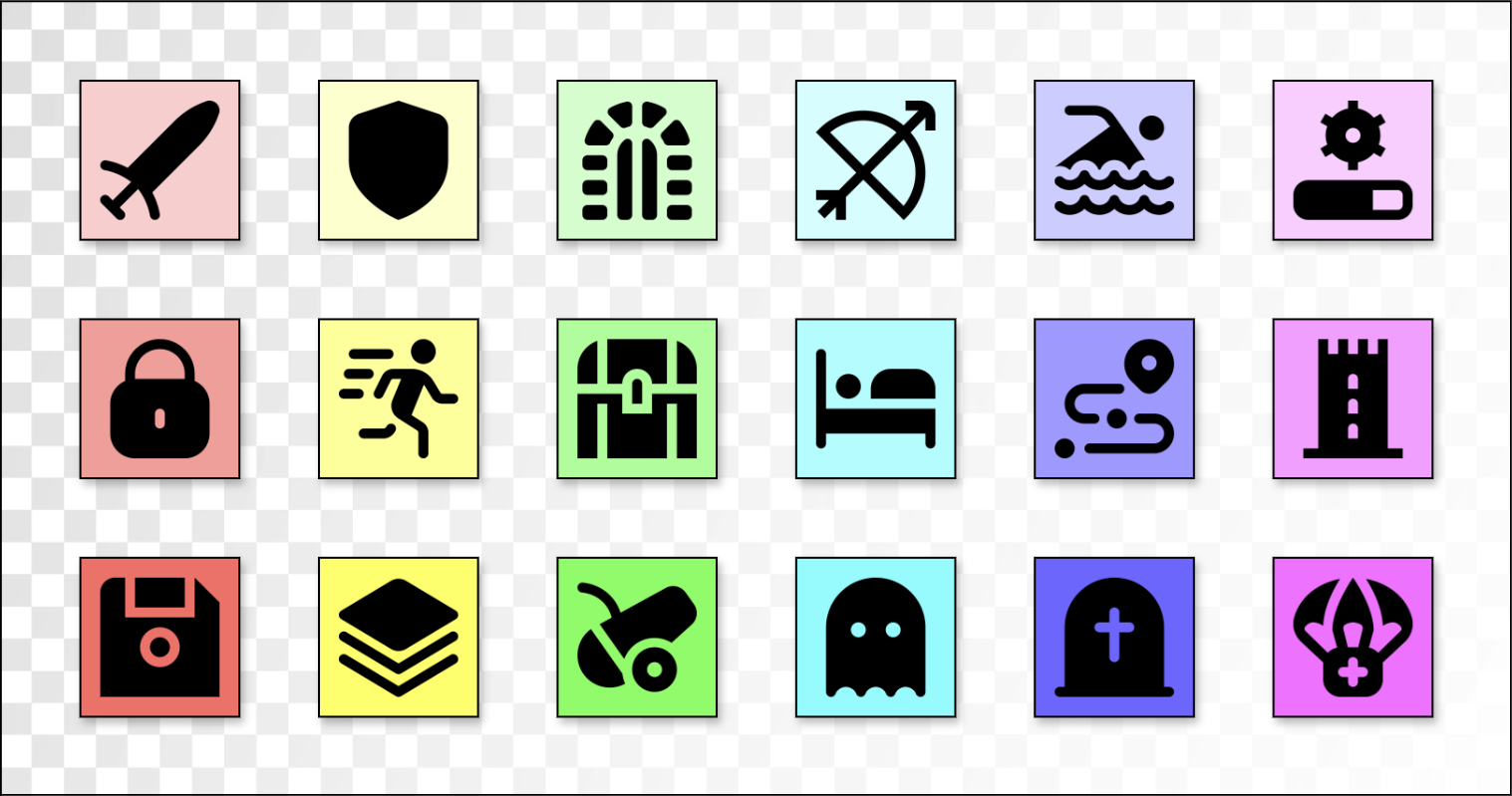
A set of 18 simple icons set atop a checkerboard grid. The icons are various colors, arrayed like a rainbow, and each icon has a solid black symbol: a sword, a shield, a person swimming, a tower, a ghost, a grave, and more.

 A Game Designer’s Brushstrokes

Let’s begin with a basic building block, one of our simplest functional units of game design: design patterns. This concept is borrowed from architecture, coined by architect Christopher Alexander and popularized in his landmark 1977 book, A Pattern Language. Alexander wanted to articulate, describe, and harness the dynamics that allowed architectural styles and forms to naturally evolve and respond to the life of their inhabitants and builders.

In the process he found a general-purpose way to describe a given art or design style from any context, not just architecture.

An image of a player who is aiming-down-sights with a destiny gun. There's fiery VFX in the air and the gun is firing a beam at an enemy combatant.

The Basics of Destiny Encounter Design

I realized that despite working on Destiny and Destiny 2 encounters for years, I’ve never really talked in any sort of detail about what goes into that. Let’s change that!

If you haven’t done it already, it’s worth reading my Fundamentals of FPS Gameplay article, which is a 5-10 minute read that I originally wrote for this Destiny article.

A screenshot from the ultimate fight at the end of the Undersea Palace in Chrono Trigger. The party members, as well as Schala and Magus, are all on the ground. The Queen sits atop Lavos, casting a spell. Crono Is standing up, his final stand.

Breaking Game Rules for Dramatic Storytelling

As game designers, one of our most powerful dramatic tools is the rule break:

Those moments when we break a long-established rule for the purposes of punctuating and aligning with a dramatic story moment

This was a key philosophy for, say, Undertale’s game design, but you see it everywhere.

This may sound obvious to some folks, but I think it’s worth looking at more closely!

The logo for the Sacred Realms podcast. It resembles the logo and typefaces for Zelda 1, but with a white, gold and red color scheme.

Sacred Realms Podcast: Phantom Hourglass

Sacred Realms is a Zelda retrospective podcast, where hosts Matthew and Lyndon Willoughby discuss the Zelda series as they replay all the games. I’m a frequent guest on the podcast, offering my perspective as both a game designer and a Zelda fan.

Despite not being a game I hold in high esteem – or perhaps because of it – Phantom Hourglass was a fascinating game to analyze and discuss. Over the course of this season of the podcast I discussed my thoughts on what they were trying to achieve, the historical context of 2007, the sea changes happening to the Zelda team, my thoughts on the touch control system, and a lot more.

A scan of what looks like a single page that has a lot of concept or illustration sketches on it, with Japanese text scribbled throughout. There are sketches of Gerudo, Twinrova, a Poe, an old concept pf Ganondorf, Ganon, a few stalfos, and more.

The Seminal Third-Person Adventure

The Legend of Zelda: Ocarina of Time was a towering achievement, a game that raised the bar far above all that had come before.

In 1998, 3D games were not new: 3D games with first-person, top-down, and side-scrolling viewpoints had already arrived, as had third-person platformers. But nobody had yet made a third-person game with both strong camera control and melee combat, especially not in a vast, immersive world. There was no blueprint, and design pitfalls awaited any team that tried.

Ocarina of Time solved that puzzle decisively. It was a model for making third-person 3D action games that were approachable and ambitious. It broke new ground in camera control, melee combat, level design, and world design. It achieved a high standard for readability and approachability; nothing like it had ever been made before, and it set a high-water mark that wouldn’t be surpassed for years.

A background image used throughout the blog website. It is a map. It shows a castle on a bluff above a lake, with a small walled town around it. The lake has rivers flowing out on either side, and is surrounded by forests. The castle is rendered in high detrail and as you go to the edges of the image the map gets sketchier and sketchier

Class Prompt: Engaging the senses

One of the ways to create a sense of place and make environments more memorable is to engage more of the player’s senses. As game creators we don’t always have a lot of avenues to do this! We can’t actually provide smells, for instance. If you’re working on a pen and paper game, as some of you are, you may not have direct access to ANY of the player’s senses, and need to instead evoke them with words.

So some useful angles to look at this from:

A background image used throughout the blog website. It is a map. It shows a castle on a bluff above a lake, with a small walled town around it. The lake has rivers flowing out on either side, and is surrounded by forests. The castle is rendered in high detrail and as you go to the edges of the image the map gets sketchier and sketchier

What is “World Design”?

The theme of this class is “World Design”, a subset of Game Design. The goal of this document is to explain what that means!

“World Design” is nebulously defined. Some companies have “World Designer” as a job title, but they don’t necessarily describe the same job. I’ve seen it used to describe traditional mission or level design work, designing vast non-linear spaces in open world games, and even the design of systems or UI related to the game world. So we will use a very broad definition in this class.

If Game Design is…

A flowchart showing steps of the character design process for Infinite Crisis

Design Docs: IC Character Case Studies

I recently posted a challenge to game designers to share more of their documentation, so academia had more examples to learn from. And then I posted an Outline of Game Documentation, with some high level descriptions of different types of game design documents. Time for me to share some!

Previously I shared a bunch of character specs from Infinite Crisis. These were finalized spec documents, representing the end point of a long iterative design process before production on the character began in earnest. This time let’s look at some of the documents that I wrote as part of that design process.